
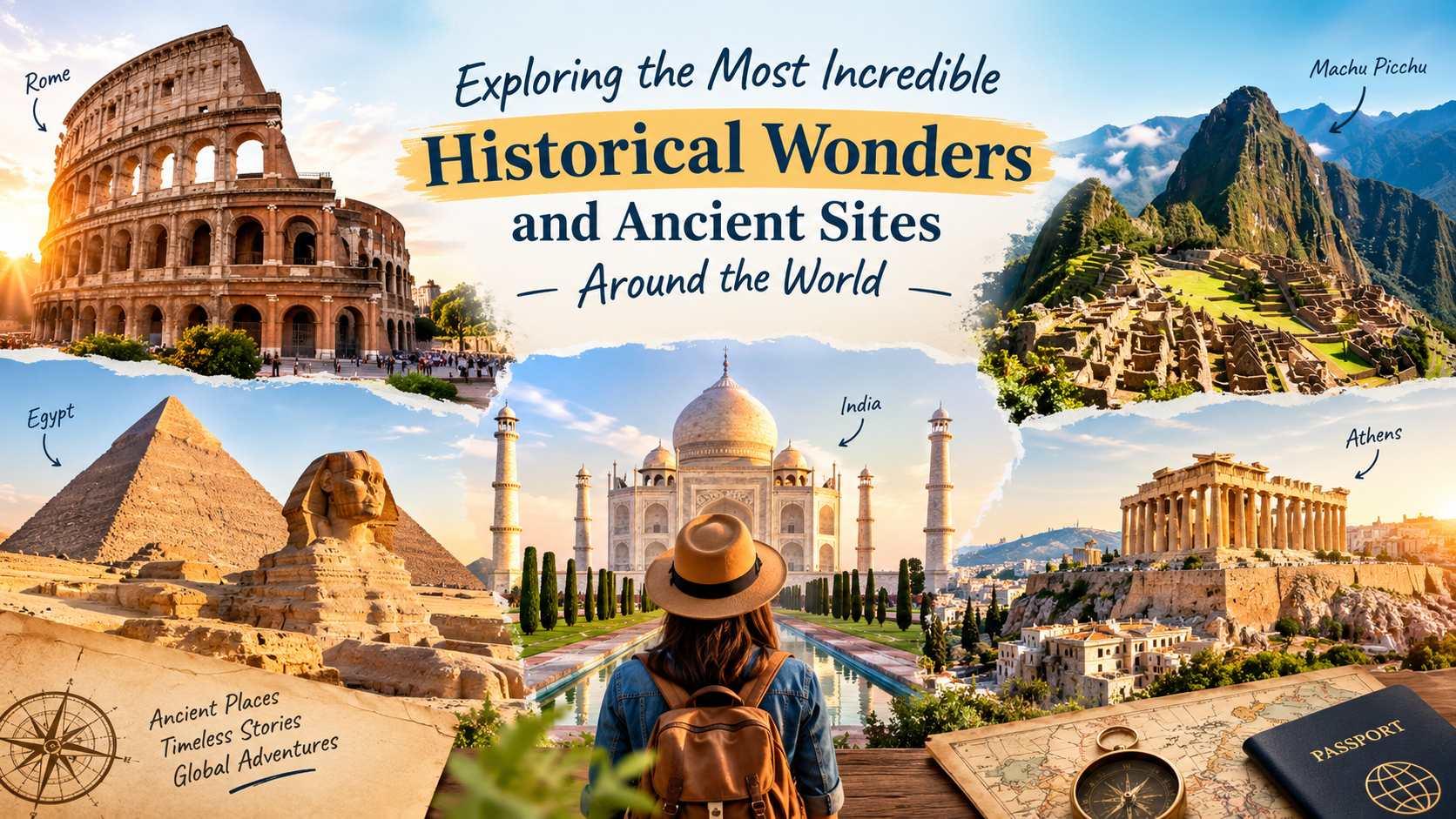
Stretching from the impossibly massive, towering golden pyramids rising aggressively out of the unforgiving Egyptian desert sands to the incredibly intricate, cloud-covered stone ruins of Machu Picchu nestled high up in the formidable Andes Mountains, the modern world is absolutely adorned with the awe-inspiring, enduring remnants of highly advanced ancient civilizations. These spectacular historical wonders do not merely stand as silent, crumbling monuments; they serve as powerful, undeniable testaments to raw human ingenuity, relentless physical endurance, and boundless artistic creativity. More importantly, these sacred spaces serve as literal windows directly into the deep, often misunderstood past, generously offering modern travelers fascinating, educational glimpses into entirely bygone eras, complex lost cultures, and the daily lives of people who lived thousands of years before the invention of modern technology. Join us on a breathtaking, immersive journey backward through the complex annals of time as we thoroughly explore some of the absolute most captivating, mysterious, and historically significant ancient sites that the world currently has to offer.
Unraveling the Mysteries
The Great Pyramid of Giza, Egypt
Standing majestically and defiantly on the dusty, sun-baked Giza Plateau just outside the sprawling modern metropolis of Cairo, the legendary Great Pyramid remains the ultimate, undisputed global symbol of ancient Egypt’s absolute architectural prowess and boundless pharaonic ambition. Built painstakingly over 4,500 years ago during the prestigious Fourth Dynasty to serve as an impenetrable, eternal tomb for the powerful Pharaoh Khufu, its staggering physical construction remains a deeply profound marvel of ancient engineering that continues to violently baffle modern historians and structural engineers alike. Originally standing at an incredible 481 feet tall, it proudly held the highly coveted title of the tallest man-made structure on the entire planet for nearly four millennia.
The sheer, almost incomprehensible logistics involved in its creation are staggering to consider. The massive pyramid is composed of an estimated 2.3 million individual limestone and granite blocks, with some of the heaviest stones weighing upwards of 80 tons each. These massive stones were quarried, transported across the mighty Nile River, and precisely cut with such unbelievable, microscopic precision that you still cannot fit a thin razor blade between the mortarless joints today. Meticulously aligned with astonishing accuracy to the true points of the compass, the Great Pyramid stands as a profound testament not just to brute physical labor, but to incredibly advanced ancient understandings of mathematics, complex astronomy, and sophisticated logistics.
Machu Picchu, Peru
Spectacularly nestled almost 8,000 feet above sea level, high up in the jagged, misty peaks of the Peruvian Andes Mountains, the legendary “Lost City” of Machu Picchu serves as a breathtaking, melancholic testament to the highly advanced, deeply spiritual civilization of the sprawling Inca Empire. Built in the mid-15th century, likely functioning as a luxurious royal estate or a highly sacred religious retreat for the powerful Inca emperor Pachacuti, the remote city was famously abandoned and completely forgotten by the outside world for centuries following the devastating Spanish conquest, until it was dramatically “rediscovered” by American explorer Hiram Bingham in the early 20th century.
The site’s incredibly precise, mortar-free construction—known formally as ashlar masonry—features massive, irregular granite blocks cut and fitted together so perfectly that they have successfully withstood centuries of violent, destructive earthquakes without collapsing. Beyond the stunning, mind-boggling stone masonry, the city features a highly complex, gravity-fed agricultural terracing system that prevented severe mountain erosion and fed the local populace, as well as an intricate network of sacred temples, precise astronomical observatories, and flowing aqueducts. The stunning, panoramic mountain backdrop perfectly frames this ancient wonder, rightfully earning it a permanent, highly celebrated place as one of the highly coveted New Seven Wonders of the World.
The Colosseum, Italy
Standing today as the ultimate, enduring global symbol of ancient Rome’s unmatched imperial grandeur, raw military power, and often brutal cultural spectacles, the magnificent Flavian Amphitheatre—universally known as the Colosseum—stands proudly as the absolute largest, most complex ancient amphitheater ever constructed in human history. Commissioned by Emperor Vespasian in AD 72 and successfully completed just eight years later by his son Titus, this massive, freestanding elliptical structure was brilliantly constructed using a complex, incredibly durable mixture of travertine limestone, volcanic tuff, and revolutionary Roman concrete.
During its bloody, highly celebrated peak, the Colosseum routinely hosted elaborate gladiatorial contests, highly exotic animal hunts featuring beasts imported directly from Africa, dramatic public executions, and even massive, highly detailed mock naval battles where the arena floor was completely flooded with water. The massive stadium was a true marvel of crowd control, explicitly designed with eighty numbered entrances capable of efficiently drawing roaring crowds of up to 80,000 diverse spectators—ranging from the wealthy emperor to common plebeians—who were strictly seated according to their specific social class. Today, exploring the dark, underground hypogeum—the complex maze of hidden tunnels and holding cells beneath the arena floor—provides a chilling, fascinating look at the incredible logistical machinery required to run the Roman Empire’s greatest, most violent show.

Preserving the Past
As the fortunate, temporary guardians of our deeply rich, shared global heritage, it is absolutely, fundamentally imperative that we work diligently, collaboratively, and tirelessly to aggressively preserve these fragile ancient sites for the benefit of all future generations. These incredible structures have miraculously survived thousands of years of punishing weather, natural disasters, and the devastating ravages of time, but they currently face incredibly severe, unprecedented modern threats from rampant over-tourism, heavy urban pollution, unchecked commercial development, and the worsening effects of global climate change.
Through massive, well-funded international conservation efforts, ongoing, respectful archaeological research, and the strict, immediate implementation of highly sustainable, low-impact tourism practices, we can successfully ensure that these irreplaceable historical wonders continue to educate, inspire, and deeply humble humanity for countless centuries to come. The heavy burden of protection falls squarely on our shoulders today.
Final Words
Ultimately, actively exploring the world’s most magnificent ancient sites is significantly more than just a fun, educational journey backward through the dusty pages of time; it is a profound, deeply emotional opportunity to physically connect with our vast, collective human story. From the impossibly precise, towering pyramids of Egypt to the heavily jungle-covered, mystical temples of Angkor Wat, each specific site generously offers a fascinating, unfiltered glimpse into the stunning ingenuity, boundless artistic creativity, and fierce, unyielding resilience of past civilizations that rose and eventually fell. As we stand in quiet awe and rightfully marvel at these incredible historical wonders, let us also constantly, vigilantly remember our massive, undeniable responsibility to aggressively protect, fund, and meticulously preserve them for all generations to come.
FAQs (Frequently Asked Questions)
1. How were ancient sites built?
Ancient sites were remarkably built using a massive, highly diverse variety of complex techniques and locally sourced materials, depending entirely on the specific civilization and the natural resources readily available in their environment. Many powerful ancient societies employed incredibly advanced, highly sophisticated engineering skills, unimaginably precise stone craftsmanship, and massively labor-intensive methods—often involving tens of thousands of skilled laborers and conscripted workers—to manually create these monumental, heavy structures that have miraculously stood the grueling test of time.
2. Why are ancient sites important?
Ancient historical sites are critically important because they provide invaluable, tangible physical insights directly into the daily lives, complex religious beliefs, and massive technological achievements of entirely past civilizations. They serve as vital, irreplaceable global cultural landmarks, massive, interactive educational resources, and profound sources of artistic inspiration, successfully fostering a much deeper, more respectful appreciation for shared human history and our complex global heritage.
3. Are ancient sites still being discovered?
Yes, absolutely! Completely new, highly significant ancient sites are still being dramatically discovered all around the world on a surprisingly regular basis, largely thanks to massive, modern advancements in non-invasive scanning technology like LiDAR (Light Detection and Ranging) and ongoing, heavily funded global archaeological research. These exciting, groundbreaking discoveries continuously contribute to expanding our understanding of the deep past and very often reveal previously entirely unknown, highly complex aspects of ancient civilizations.
4. How can I visit ancient sites responsibly?
When physically visiting highly fragile ancient sites, it’s critically important to strictly respect all posted local regulations, deliberately avoid touching or climbing on deteriorating, fragile structures, and absolutely refrain from removing any loose artifacts or selfishly defacing monuments with graffiti. Intentionally choosing highly responsible, certified eco-tour operators and actively supporting strict sustainable tourism initiatives can also significantly help minimize the massive, negative environmental and physical impacts that heavy tourist foot traffic places on these precious sites.
5. What can I do to support the preservation of ancient sites?
You can actively, meaningfully support the ongoing physical preservation of ancient sites by loudly raising public awareness about their critical historical importance, making direct financial donations to reputable, international non-profit organizations firmly dedicated to historical conservation efforts, actively volunteering your time for local archaeological digging projects, and passionately advocating for strict government policies that heavily prioritize cultural heritage protection and restrict damaging urban encroachment.